Categories
Uncategorized

Electro-shockin, beta-blockin

A new study indicates humiliation could be the strongest of human emotions trumping sadness, disgust, surprise, etc. Just sit and think about that. Of all the things that happen to us, humiliation ranks at the very top. If you remember something like it was yesterday, there’s a non-trivial chance that on that date, at that time, you endured just a tinge (or way, way more) of embarrassment.

Humiliation is a constant, nagging fear for high-wire music performers. Don’t practice before a lesson? Get dressed down by your teacher. Miss notes at an orchestra practice? Get singled out by the conductor. For god’s sake, we have masterclasses where students’ inadequacies are put on display for a captive audience! Suddenly I’m feeling flush. Our beloved musicians fall victim to symptoms of nerve-wracking performances: sweaty palms, shaking hands, chest and muscle tightness, tunnel vision. It’s like a list of Cialis side effects.

Nobody wants to look like an ass. When you get out on that stage anything can happen. Part of the reason audiences go to shows is to see whether the performer can pull it off — that horn solo in Ein Heldenleben, the violin acrobatics of Symphonie Espagnole. Will she fall flat on her face? Can she survive??? As sports fans we like our triumphs & failures clearly defined. Ditto music

In 1962, chemistry wizard James Black found a new medicinal treatment for patients with heart disease. Black synthesized propranolol and pronethalol in his lab, and he called them “beta-blockers” for the way they suppressed the body’s fight-or-flight response. Captain Black’s invention helped patients with hypertension or a history of heart attacks to avoid heart arrhythmias or worse. It bought the patient some breathing room — folks mere steps away from a widowmaker got a new lease on life.

So it just so happens the symptoms that Dr. Black helped patients avoid are some of the very symptoms that affect our beloved entertainers — the aforementioned sweaty palms and muscle tightness, the waves of nerves a tough performance can provoke. And wouldn’t you know it, doctors broke the walls down and prescribed beta blockers for performers. No numbers exist on beta blocker usage among classical musicians, but suffice to say, anecdotally, they get some play.

I tried beta blockers when I was 21. I was pretty sure they weren’t working — I waited to perform, frantic and scatter-brained like normal. But the minute I tuned up I knew something was up. Minimal sweat. No bow shakes. Deep (not necessarily profound) relaxation. Afterwards, friends told me I sounded great. Hard to argue with that feedback. I will not lie to you, it made performing 20 percent easier out of the gate. Eventually my prescription lapsed and I went back to performing the sweaty, jumpy way.

When you poll Americans our fear of public speaking outranks our fear of death. Why do we get so nerved up? It is our pathological aversion to humiliation. It’s so obvious it’s ridiculous to type or say. But we can’t stand being made the fool, let alone humiliating ourselves in front of hundreds/thousands/millions

Beta blockers afford a small amount of control in a fluid and unpredictable situation. Other things work too — I know people who down a beer or a cocktail before playing, others smoke that medicinal, and there’s always natural remedies — but what harm, really, are we talking about here?

Would you be disappointed finding out that your heroes — Jay Friedman, Vladimir Horowitz, Yehudi Menuhin, Leontyne Price — were dosed up on propranolol on the regular? Does the use of the performance-enhancing drugs make the high wire seem a little lower, a little less threatening — and maybe … less exciting?

My contention is this. If you are feeling the music you’re feeling it. Whether or not your musical gods get fixed up beforehand doesn’t affect your good time. (But you may stop and wonder now.) The NFL doesn’t test for Human Growth Hormone. The NBA has a laughable anti-marijuana policy (be easy, Michael Beasley). Somehow we’re able still to enjoy both. We may not be able to avoid getting our asses handed to us by imperious teachers in lessons and masterclasses, but at least there’s one simple way, if you want it, to keep that strongest of human emotions at bay when push comes to shove.
Categories
Uncategorized

Classical linkstagram

  • ¡Osmo! Minnesota Orchestra has its conductor again.
  • A classical instrument lending library.
  • Sinfini Music whipped up the Top 20 Pianists of All Time, just to stoke your seething hatred for lists.
  • The Seattle Symphony is going to do a classical version of Baby Got Back with Sir Mix-A-Lot.
  • Just like your favorite rapper, Daniel Barenboim now has his own boutique classical label called PERAL.
  • The BBC Proms is learning how to Photoshop.
Categories
Uncategorized

When it’s time to throw in the towel

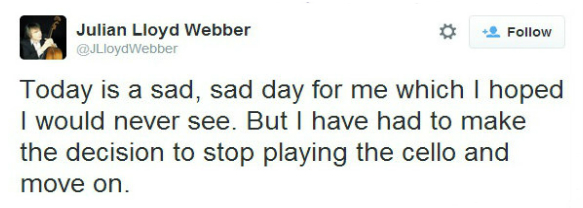
Cellist Julian Lloyd Webber is retiring from the cello.JLW is the brother of billionaire Andrew Lloyd Webber of Cats fame. His list of premieres spans 50 works and includes composers like Joaquín Rodrigo (sweet) and Phillip Glass (…). JLW also happens to be the first musician awarded a busker’s license for the London Underground, that finest of all concert halls.

Now all that is done. Webber suffered a herniated disk in his neck (posture pegs my dude!) and announced that he’s stepping away from the cello.

jlwtweet-webwebweb

First of all, I need follow JLDubs on Twitter. Second, retiring at age 63 from a pro cello career shouldn’t be sour grapes, especially considering the high-flying run he had.

Third, the music vocation is an odd and unending one. The insane and the prodigious (and the insanely prodigious) start pro careers as soon as they can stand upright. At the end of that road there’s nothing that remotely resembles a consensus retirement age. If you can play, you play. Some retire to teach (and play a little less). Only a few flame out and take their bad vibes with them.

jobmcds

But how do musicians know when to throw in the towel? When is enough enough?

An old teacher of mine, Peter Howard, used to say that he would stop performing before he embarrassed himself. These things are fairly subjective but I always thought that was a sensible decision.

We’re not talking about putting an old racehorse down here. A performer at a certain age has accrued a bundle of information: what music still works after hundreds of spins, what festivals are the best summer jump-offs, who cooks up the illest music projects, who’s kept what kind of company in off-hours,  and how to move in a room full of vultures. None of that’s easy to leave behind.

In the end you just give thanks for going great guns, for whatever length of time you got and whatever forces that let you make music for a living. Not just musicians wrestle with retirement and relevance, and at least your office had good music.

Julian Lloyd Webber is not gone and he’s not forgotten. He’s probably got some cool-ass professorship lined up, and he’ll always be able to shoot skeet on his brother’s massive estate if he gets bored. But we have to learn to pay tribute, to appreciate the “elder” (63 is not elder) statespeople among us. Because who knows when it ends?

In memoriam for JLW’s career, 1971 – 2014, and for players whose performing lives deserve a similar splash of a 40-ounce on the pavement.

“Always go to other people’s funerals, otherwise they won’t come to yours.” — Yogi Berra

Categories
Uncategorized

These classical jocks enjoy robust popularity, the fawning adoration of their peers

The Billboard classical charts may only be interesting to classical watchers & weirdos. Nonetheless, we can glean a few pearls of wisdom doing the numbers from this week’s album sales.

  • Easter bounce: the Mormon Tabernacle Choir put together He is Risen for the rollicking April holiday. That’s what’s known as excellent timing — the MTC grabbed that #1 chart spot. Hustle-nomics 101.
  • Our Missouri ladies are still holding strong at #3. Lent at Ephesus by the Benedictines of Mary, Queen of the Apostles has been steady for nine weeks and counting. Sensing a strong religious component of top-sellers? This is about where it ends.
  • Classical “grab bag” albums are just tremendously popular. Tremendously, nauseatingly popular. To wit: album numbers 2, 4, 7, 8, 9, 11, 12, 13, 14, 17 and 18 (and arguably 22 and 24) all feature standard classical fare, usually collated by composer name, virtually indistinguishable from the previous batch of best-ofs.
  • Iranian composer & musician Hafez Nazeri is charting (#5) with an album original material (whoa) composed as a tribute to the poet Rumi. The Rumi Symphony Project features Deepak Chopra (yes, that one) spitting Rumi verses, along with Hafez Nazeri’s father, Shahrma, a well-known Persian classical and Sufi singer. This one goes.
  • Kronos Quartet debuted at the #19 spot with their album A Thousand Thoughts. People who have opinions on such things have basically panned the album (albeit very nicely). Why does that matterITDOESN’TMATTERWHATYOUTHINK.** The Kronos discography is unassailable. Those guys could sequester themselves in a don-size villa in Cabo San Lucas and release an annual In Through The Out Door cover album and their legacy would remain unblemished. Fans don’t give a flying f.

**Apologies to The Rock.

Categories
Uncategorized

Classical Link Rodeo

  • Take this NPR quiz to ID some big concertmaster solos.
  • Joakim Noah’s photo-op on the Chicago Lyric Opera stage.
  • John Luther Adams won a Pulitzer for his piece Become Ocean, which makes the case that all composers have to be named John Adams.
  • Utah Symphony’s MIGHTY 5 TOUR features free performances at five different Utah National Parks.
  • Sign of the times: a Macedonian orchestra landed the score for Draft Day by underbidding a Hollywood orchestra.
  • Post-Easter: “Bach’s Passions are the greatest musical works ever written for Good Friday services.”
Categories
Uncategorized

Sometimes courting disaster means living with disastrous results

Megadeth guitarist Dave Mustaine & the San Diego Symphony just wrapped a collaboration called “Symphony Interrupted.” It did not go so well.

This was parody-level bad. Could this be real life?

Screen shot 2014-04-14 at 10.43.13 PM

Yes, apparently.

Screen shot 2014-04-14 at 10.44.52 PM

Here we have a prime example of a collaboration that looks great on paper (metal + classical, two not-so-strange bedfellows) that just self-destructs in its execution. It’s easy to imagine a world where “Symphony Interrupted” would have been successful, and when success begets success there’s a tremendous upside for everybody involved.

Any number of things may have torpedoed this — lack of rehearsals, lack of coordination between the SDS and Mustaine’s camp, unease with the material, or a half-hearted commitment to doing this show.

What I do know is that audiences deserve better. When you’re charging them money to see a show they want a SHOW. This is what they got instead.

Categories
Uncategorized

Columbus Symphony gives amateurs their star turn

The Columbus Symphony conducted a little experiment recently by enlisting amateur musicians to join their orchestra’s ranks. The Symphony called it “Side by Side,” and invited 50 people to rehearse classical warhorses like Beethoven’s Fifth Symphony and Sibelius’s Finlandia.

I remember the first time I sat down in the cello section of the Dubuque Symphony, my hometown orchestra of record. I’d seen so many of their shows over the years. They were Up There, performing for their fans, like musical celebrities.

When I was was in middle school the DSO let me play a July 4th pops show at the Dubuque County Fairgrounds. I was starstruck playing with my idols. “Holy hell, how do I hang in on the Firebird finale? How long will it take me to turn the corner on that beastly Star Wars cello part?” The stage was in front of a dirt stock car track. Best gig of my life up to that point.

Here’s a video of the Columbus Symphony’s experiment. Worth a shot in other places? I’d say so.

A commenter over at Norman Lebrecht’s Slipped Disc (where I stole this news item from) points out many US orchestras are already doing this — Buffalo Phil, Minnesota Orchestra, a bunch more. Sweet.

Categories
Uncategorized

Demystifying Stradivari

Classical music is all about pedigree.  When it comes to string instruments, the name Stradivari means violins that purr like Ferraris, cellos as coveted as Louis Vuitton one-time wears, violas rarer than Nintendo gold cartridges. They command a price commensurate with reputation.

Gucci Gucci Louis Louis Fendi Fendi Prada

Two factors play into this — one, Stradivari instruments are extremely old, well-made and -preserved instruments; and two, when financiers and real estate moguls zoom in on new investment opportunities, woe unto those who cross them. These wood boxes with strings and fancy varnish get pretty expensive, pretty quick.

Young guns looking for that ultimate edge gravitate to the Stradivari and Guarneri schools of luthierism. Because this requires a six- or seven-figure outlay, either a loan or a benefactor is essential for bankrolling the venture.

But what happens when you find out the golden calf ain’t so golden? What if the hype machine unnaturally inflated the value of some of the music’s most desirable instruments?* New research out of the Proceedings of the National Academy of Sciences pours boiling coffee on our champagne party.

Researcher Claudia Fritz took 15 new instruments, nine old Italian instruments (six by Stradivari, two Guarneri ‘del Gesu,’ and one 18th-century Italian), and had ten upper-echelon violinists play them in a double-blind study.

Violinists were asked to play and critique the violins in a formal concert hall somewhere in Paris, using pieces familiar to classical audiences — the Franck Sonata, Beethoven’s Kreutzer Sonata, and Sonata #1 by Brahms.

The results? These top-flight violinists preferred newer violins. What’s more, they had trouble identifying the Strads and del Gesus.

This Paris study comes on the heels of one conducted in an Indianapolis hotel room in 2012 during a violin competition. The Indianapolis ordeal prompted an amount of anger due to its perceived lack of rigor —  players only got about 20 minutes to fool around with the violins, and it was staged in a dry room rather than a concert hall.

The latest study by Claudia Fritz et al. confirms that what happened in the dead of night in an Indiana hotel room was no fluke. An impeccable pedigree and heavy pricetag can’t fool the ear or the fingers. They want what they want.

See the introductory video to the latest Strad-test below.

*Has artificial inflation ever happened in the history of investments, even once? Of course not!

Categories
Uncategorized

The piano is the orchestra and Hauschka is the beat conductor

Hauschka is the nom de guerre of German pianist Volker Bertelmann. Bertelmann cut his teeth on classical piano — like so many of us, banging out shaky tunes on an upright, honing the craft. When it came time to strike out on his own Bertelmann took it a step further, opting for prepared pianos and steady house beats.

Bertelmann’s new album, Abandonded Cities, is Bertelmann mining that same groove. He wrote and performed all the music on the album. For his efforts the album — not strictly classical, I won’t fight you there, but certainly not not classical — currently sits at #20 on the Billboard classical charts.

To get a sense I dipped into iTunes previews and streamed a load more on Spotify. There’s a lot to like on Abandoned Cities, like “Elizabeth Bay” for one.

I leave you with a Hauschka performance of “Mt. Hood” from 2010. Follow the bouncing balls:

Categories
Uncategorized

Vulfpeck out-John-Cages John Cage

Composer John Cage flipped the concert-going experience on its head with his DGAF piece 4’33” — which baffled audiences and propelled Cage to fame and infamy in under five minutes.


ENTER VULFPECK.

Los Angeles outfit Vulfpeck crafted a magnum opus entitled “Sleepify,” an album composed entirely of …. silence, in the finest John Cageian tradition. Here’s a promo for it:

Each track of Vulfpeck’s “Sleepify” runs about 30 seconds. The goal here — besides putting you to sleep faster than double-stacking Ambien — is to get as many fans as possible to stream the album on Spotify. Vulfpeck will then fund a tour with the (relatively meager) royalties from all those Spotify streams.

Feeling adventurous, curious or sleepy? Want to help Vulfpeck play a show in your neck of the woods? Go here or here, and to hear what they sound like in their not-so-conceptual incarnation, click here.